Content that costs less and learns more
Most beauty brands overspend on content because the workflow is too slow to test, too expensive to iterate, and too disconnected from commercial performance data.
Why content costs keep rising without proportional return
Your team produces assets every month. You spend on agencies, freelancers, and production. But nobody can tell you which creative drove the last 20% of sales. The problem is not volume. It is that your content operation has no feedback loop between spend and commercial outcomes.
Where content cost and performance break
Slow testing cycles
By the time new creative is approved and live, the moment has often passed. Monthly refresh cycles cannot keep up with platform algorithm changes or seasonal windows.
Rising cost per asset
Production costs climb every quarter but cost-per-acquisition improvement does not follow. More spend does not mean better results.
No commercial learning loop
The team produces content but the organisation does not learn. Nobody tracks which hooks, formats, or angles actually convert at scale.
What most brands do
Most brands respond by producing more content, hiring more freelancers, or switching agencies. None of these fix the structural issue. Without a system for testing, measuring, and learning, more content just means more cost.
What Beauty 2.0 builds instead
We build a content system that produces more variation for less cost, tests faster, and feeds commercial learning back into the next brief. AI-assisted variation generation creates 50-100+ on-brand options per brief instead of 3-5. Structured A/B testing replaces guesswork with data. Commercial performance tracking shows exactly which creative drives revenue.
What you get
Expected outcomes
Faster testing
Move from monthly to weekly creative rotation with AI-assisted variation.
Lower cost per asset
Produce 50-100+ variations per brief instead of 3-5, at a fraction of the current per-asset cost.
Clear performance data
Know which hooks, formats, and angles convert before you scale them across channels.
Better agency utilisation
Your agency focuses on strategy and hero creative. Variation and testing are handled by the system.
Who this is for
- CMOs and marketing leads spending GBP 10K+/month on content with no per-asset ROI data
- Content managers running production calendars that feel increasingly expensive without proportional performance improvement
- Founders who know content matters but suspect the operation is less efficient than it should be
Implementation timeline
Initial audit
1 week
System build
4-6 weeks
First measurable results
6-8 weeks.
Not ready for the full system?
Start with a focused audit
Get a clear diagnosis of where the problem sits and what to fix first. No commitment to a full system build until you have the evidence.
Common questions
How quickly does this show results?
Most brands see measurable cost-per-asset improvement within 6-8 weeks of implementation. Testing speed improvements are visible within 2-3 weeks.
Does this replace our agency?
No. It makes your agency more effective by handling routine variation and testing, so your agency focuses on strategy and hero creative where their expertise matters most.
What if our brand has strict creative guidelines?
The system works within your brand guidelines. Variation generation is trained on your existing approved creative, so outputs are on-brand by default.
Where this solution runs
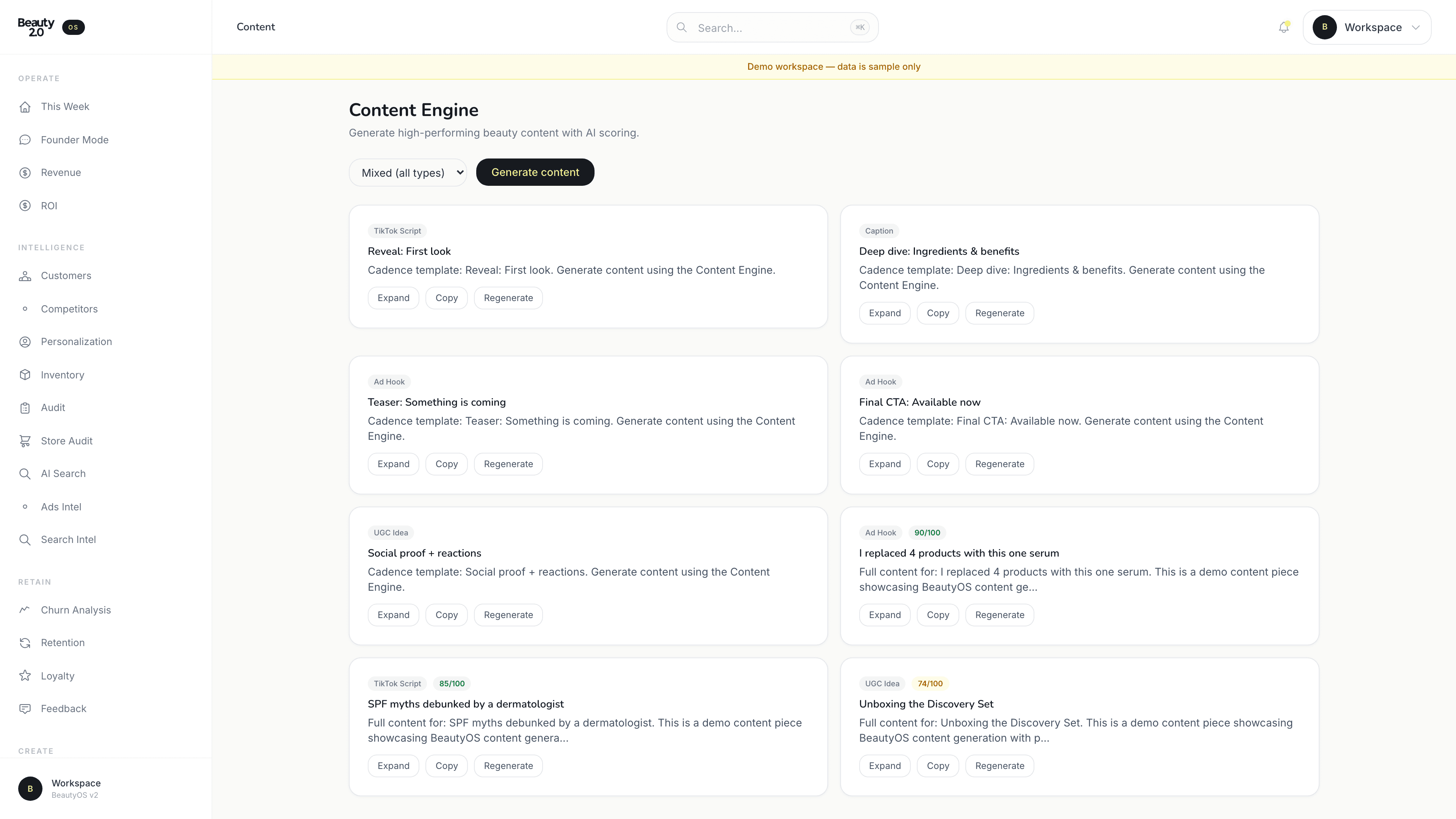
Every Beauty 2.0 engagement persists into the operating system. Track it, review it, and iterate without rebuilding the data each time.
Go deeper on this
Articles, resources, and definitions that connect to this solution.
From the blog
Cakes Body Did $100m in Three Years on TikTok, Then Built a Studio. The Documentary Got 371,600 Views.
DTC GrowthAïza Grew Revenue Ninefold With About 20 Staff and One Product Doing a Third of Sales. That Combination Is the Story.
DTC GrowthMilani Doubled to $250m Holding Three Price Points and One Customer. Most Brands Fragment Instead.
In the glossary
Ready to fix this?
Start with a discovery call to talk through what is happening, or book an audit if you want a structured diagnosis first.