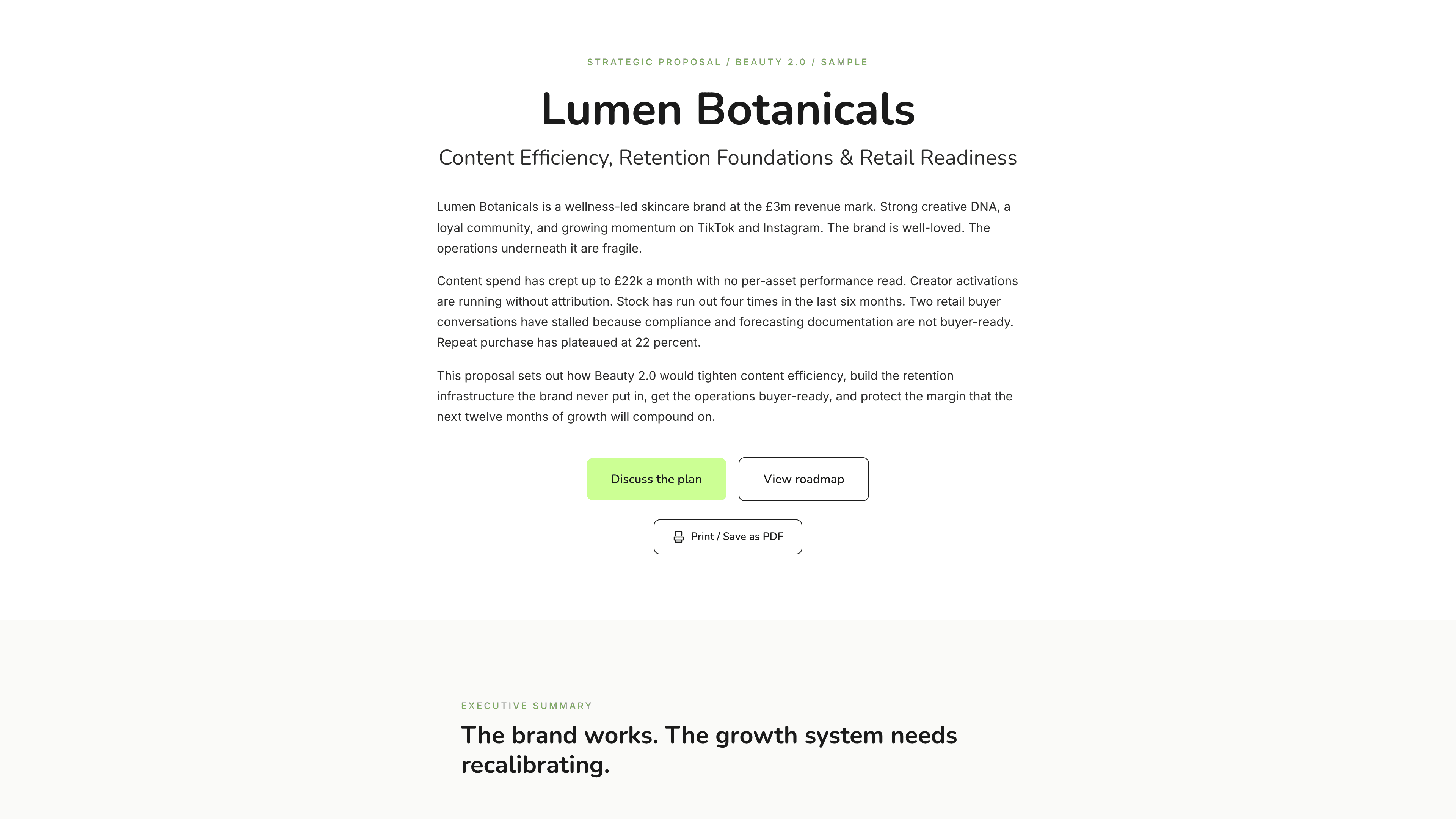
Strategic Proposal / Beauty 2.0 / Sample
Content Efficiency, Retention Foundations & Retail Readiness
Lumen Botanicals is a wellness-led skincare brand at the £3m revenue mark. Strong creative DNA, a loyal community, and growing momentum on TikTok and Instagram. The brand is well-loved. The operations underneath it are fragile.
Content spend has crept up to £22k a month with no per-asset performance read. Creator activations are running without attribution. Stock has run out four times in the last six months. Two retail buyer conversations have stalled because compliance and forecasting documentation are not buyer-ready. Repeat purchase has plateaued at 22 percent.
This proposal sets out how Beauty 2.0 would tighten content efficiency, build the retention infrastructure the brand never put in, get the operations buyer-ready, and protect the margin that the next twelve months of growth will compound on.
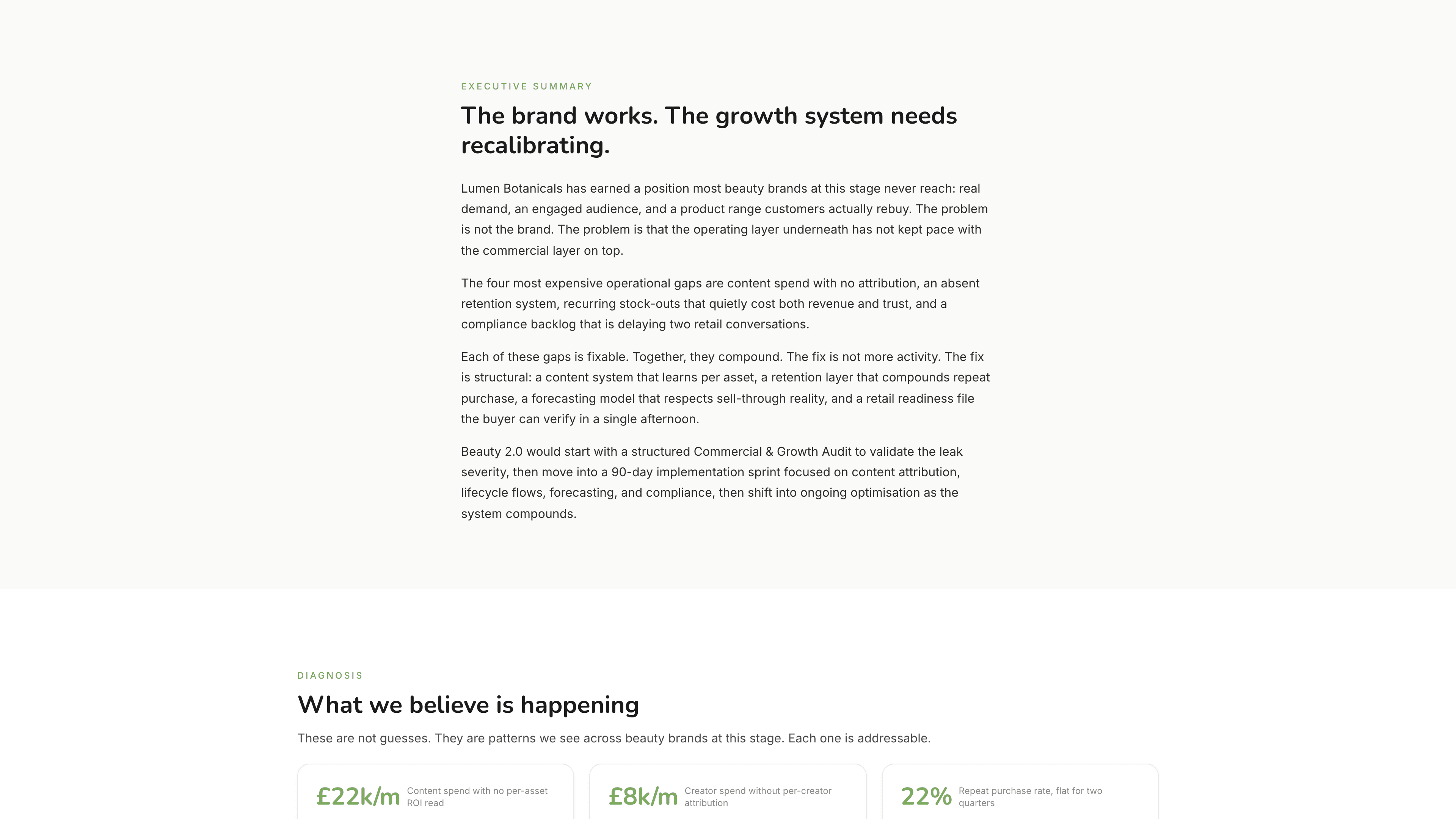
Executive summary
Lumen Botanicals has earned a position most beauty brands at this stage never reach: real demand, an engaged audience, and a product range customers actually rebuy. The problem is not the brand. The problem is that the operating layer underneath has not kept pace with the commercial layer on top.
The four most expensive operational gaps are content spend with no attribution, an absent retention system, recurring stock-outs that quietly cost both revenue and trust, and a compliance backlog that is delaying two retail conversations.
Each of these gaps is fixable. Together, they compound. The fix is not more activity. The fix is structural: a content system that learns per asset, a retention layer that compounds repeat purchase, a forecasting model that respects sell-through reality, and a retail readiness file the buyer can verify in a single afternoon.
Beauty 2.0 would start with a structured Commercial & Growth Audit to validate the leak severity, then move into a 90-day implementation sprint focused on content attribution, lifecycle flows, forecasting, and compliance, then shift into ongoing optimisation as the system compounds.
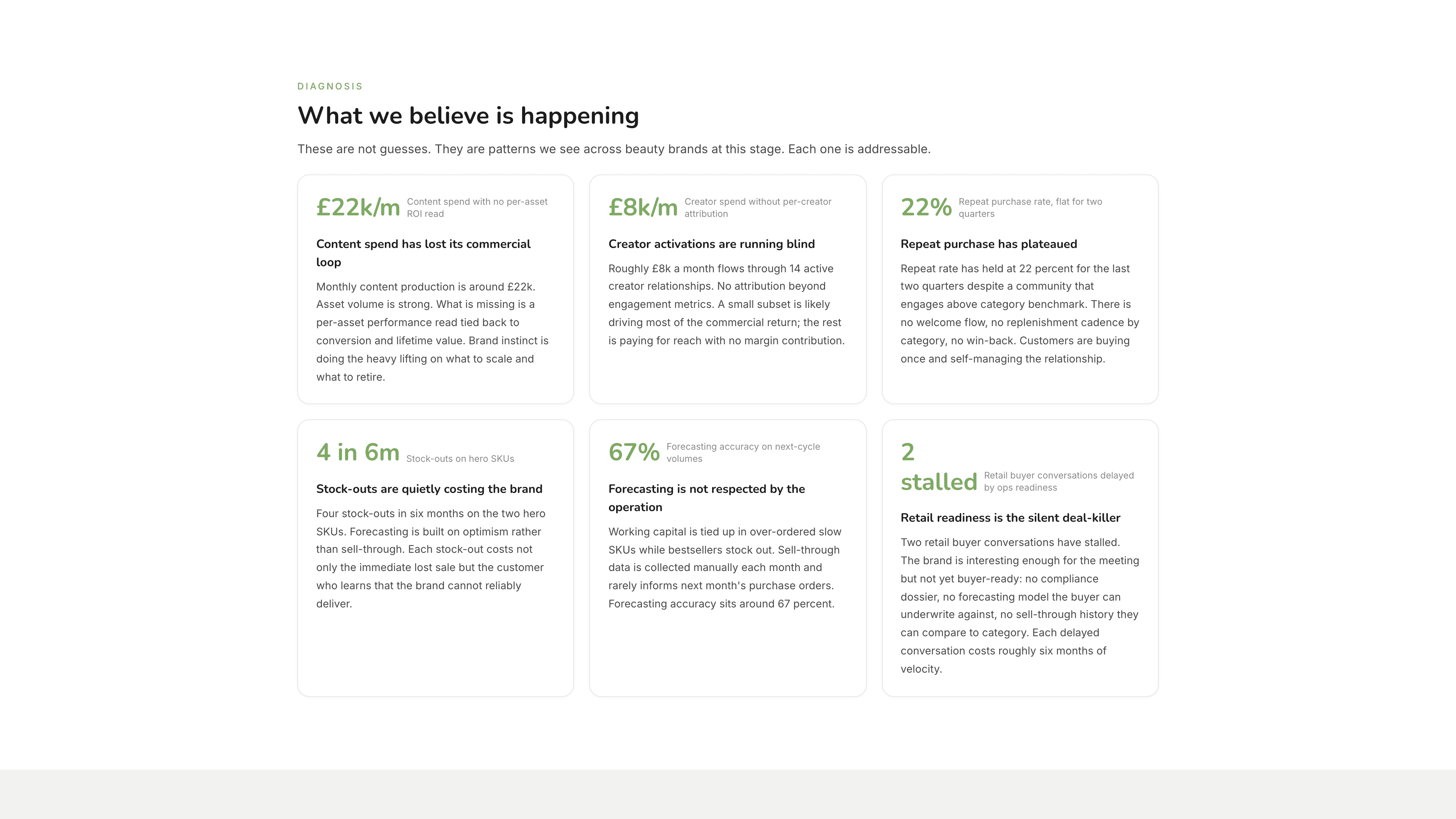
Diagnosis
These are not guesses. They are patterns we see across beauty brands at this stage. Each one is addressable.
Monthly content production is around £22k. Asset volume is strong. What is missing is a per-asset performance read tied back to conversion and lifetime value. Brand instinct is doing the heavy lifting on what to scale and what to retire.
Roughly £8k a month flows through 14 active creator relationships. No attribution beyond engagement metrics. A small subset is likely driving most of the commercial return; the rest is paying for reach with no margin contribution.
Repeat rate has held at 22 percent for the last two quarters despite a community that engages above category benchmark. There is no welcome flow, no replenishment cadence by category, no win-back. Customers are buying once and self-managing the relationship.
Four stock-outs in six months on the two hero SKUs. Forecasting is built on optimism rather than sell-through. Each stock-out costs not only the immediate lost sale but the customer who learns that the brand cannot reliably deliver.
Working capital is tied up in over-ordered slow SKUs while bestsellers stock out. Sell-through data is collected manually each month and rarely informs next month's purchase orders. Forecasting accuracy sits around 67 percent.
Two retail buyer conversations have stalled. The brand is interesting enough for the meeting but not yet buyer-ready: no compliance dossier, no forecasting model the buyer can underwrite against, no sell-through history they can compare to category. Each delayed conversation costs roughly six months of velocity.
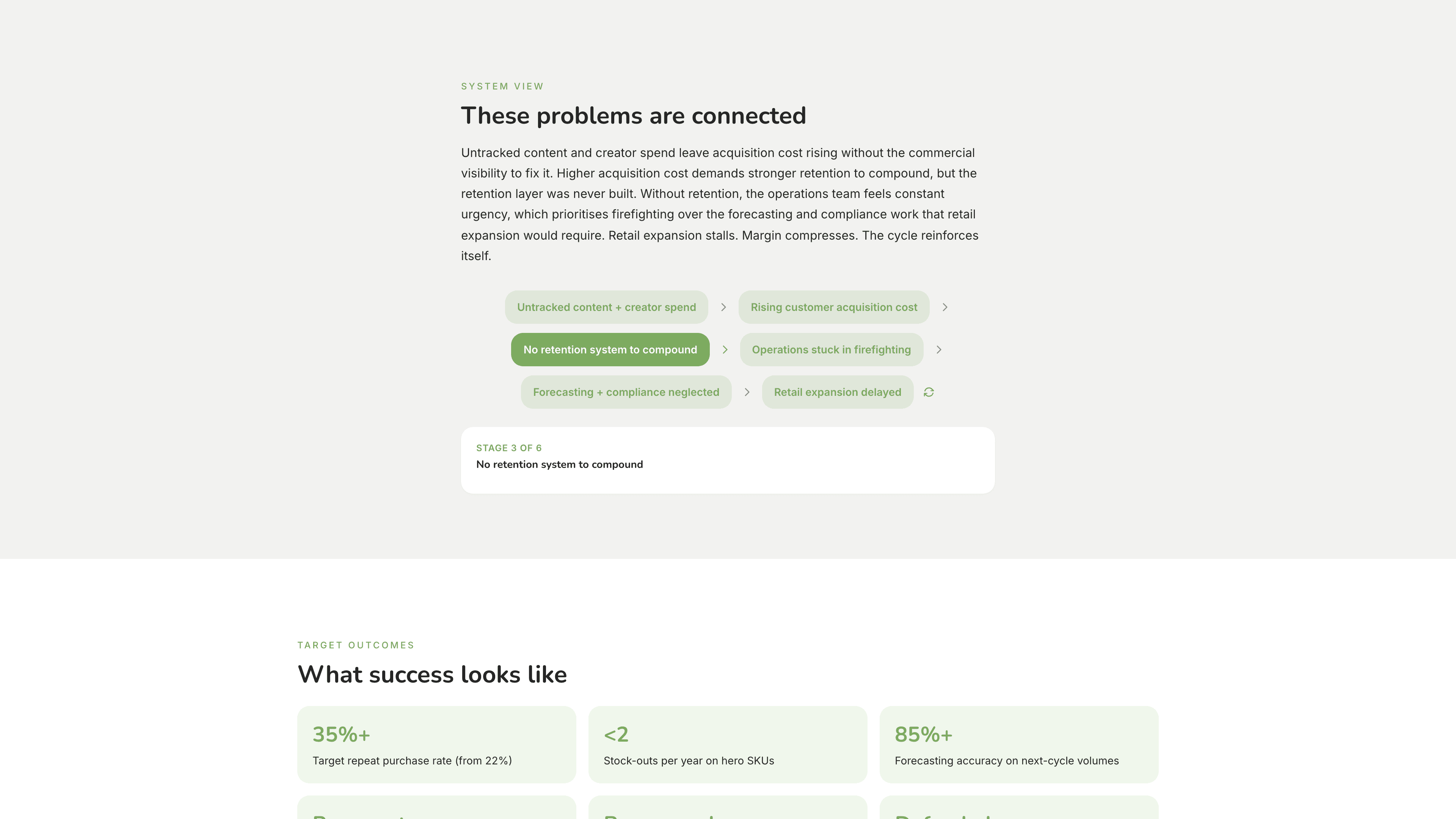
System view
Untracked content and creator spend leave acquisition cost rising without the commercial visibility to fix it. Higher acquisition cost demands stronger retention to compound, but the retention layer was never built. Without retention, the operations team feels constant urgency, which prioritises firefighting over the forecasting and compliance work that retail expansion would require. Retail expansion stalls. Margin compresses. The cycle reinforces itself.
Stage 1 of 6
Untracked content + creator spend
1. Untracked content + creator spend
2. Rising customer acquisition cost
3. No retention system to compound
4. Operations stuck in firefighting
5. Forecasting + compliance neglected
6. Retail expansion delayed
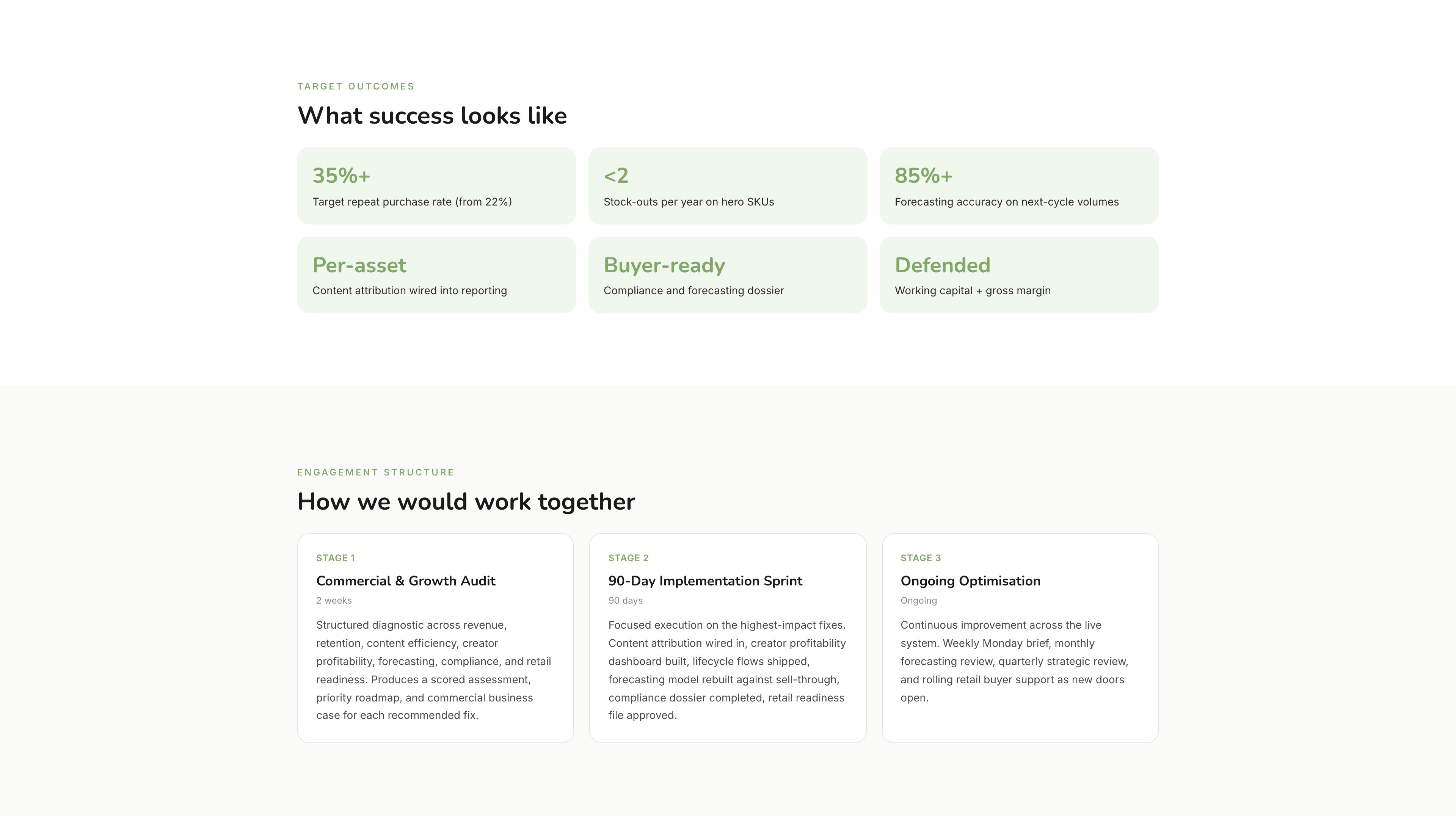
Target outcomes
35%+
Target repeat purchase rate (from 22%)
<2
Stock-outs per year on hero SKUs
85%+
Forecasting accuracy on next-cycle volumes
Per-asset
Content attribution wired into reporting
Buyer-ready
Compliance and forecasting dossier
Defended
Working capital + gross margin
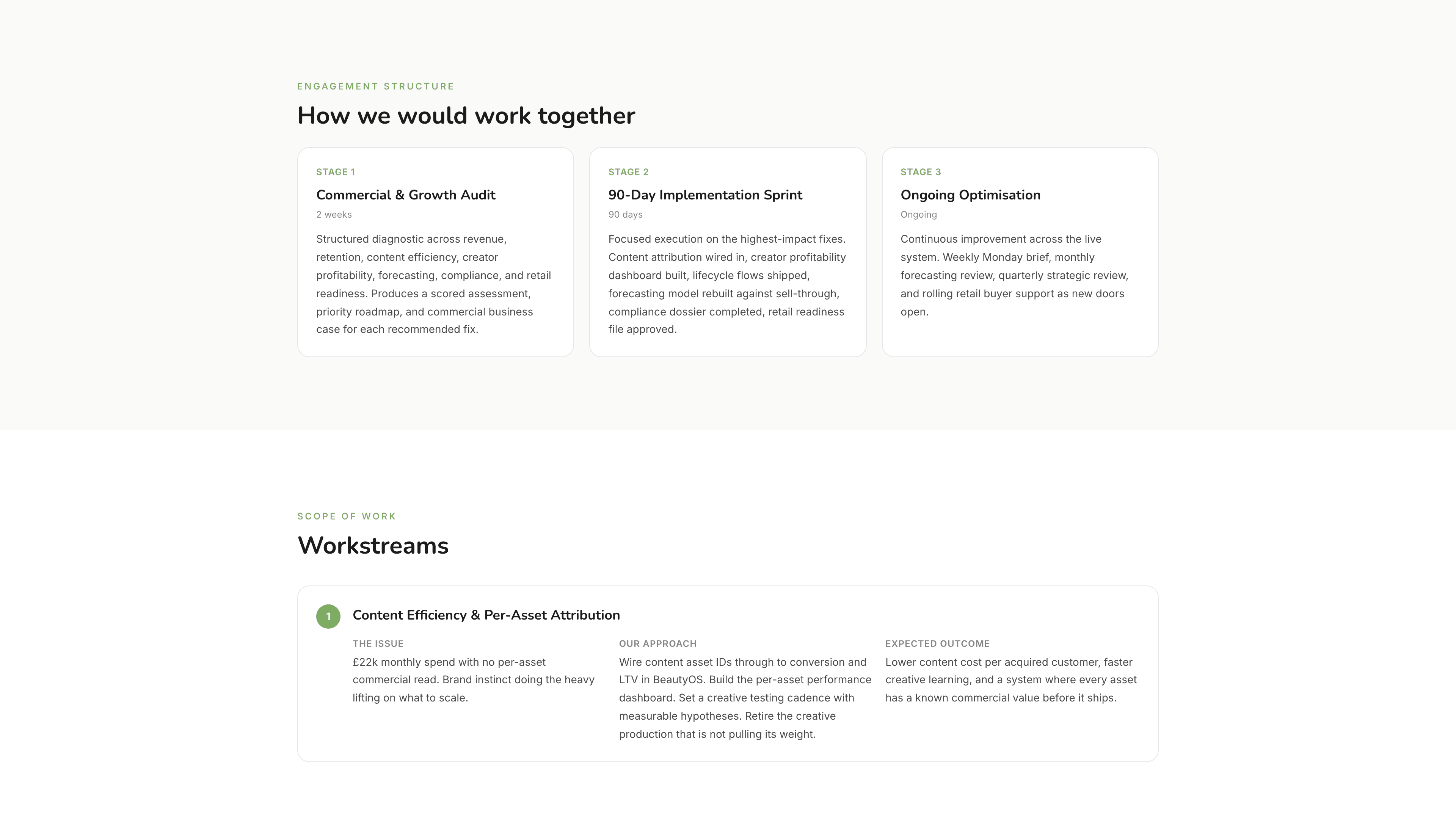
Engagement structure
Stage 1
2 weeks
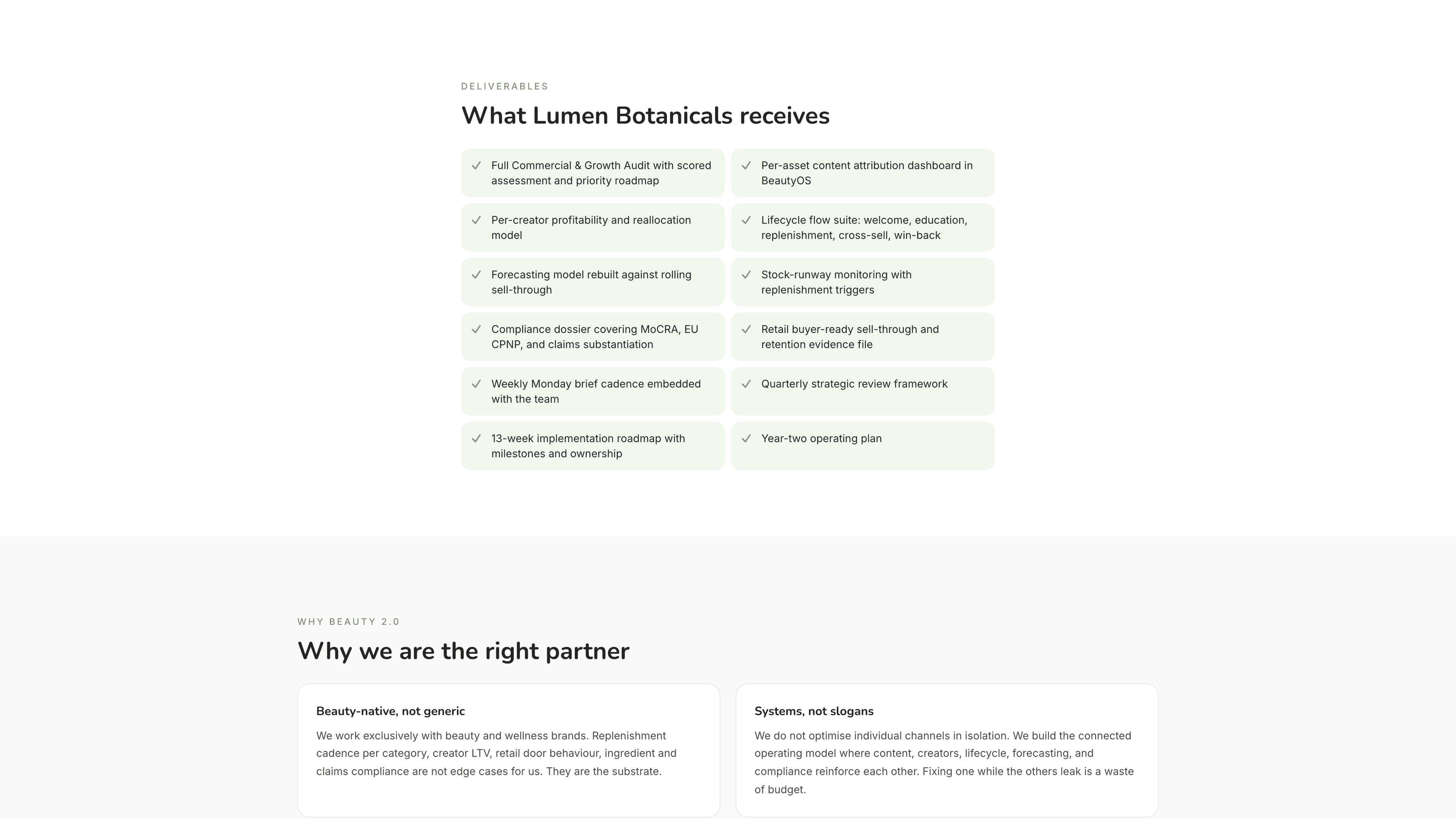
Structured diagnostic across revenue, retention, content efficiency, creator profitability, forecasting, compliance, and retail readiness. Produces a scored assessment, priority roadmap, and commercial business case for each recommended fix.
Stage 2
90 days
Focused execution on the highest-impact fixes. Content attribution wired in, creator profitability dashboard built, lifecycle flows shipped, forecasting model rebuilt against sell-through, compliance dossier completed, retail readiness file approved.
Stage 3
Ongoing
Continuous improvement across the live system. Weekly Monday brief, monthly forecasting review, quarterly strategic review, and rolling retail buyer support as new doors open.
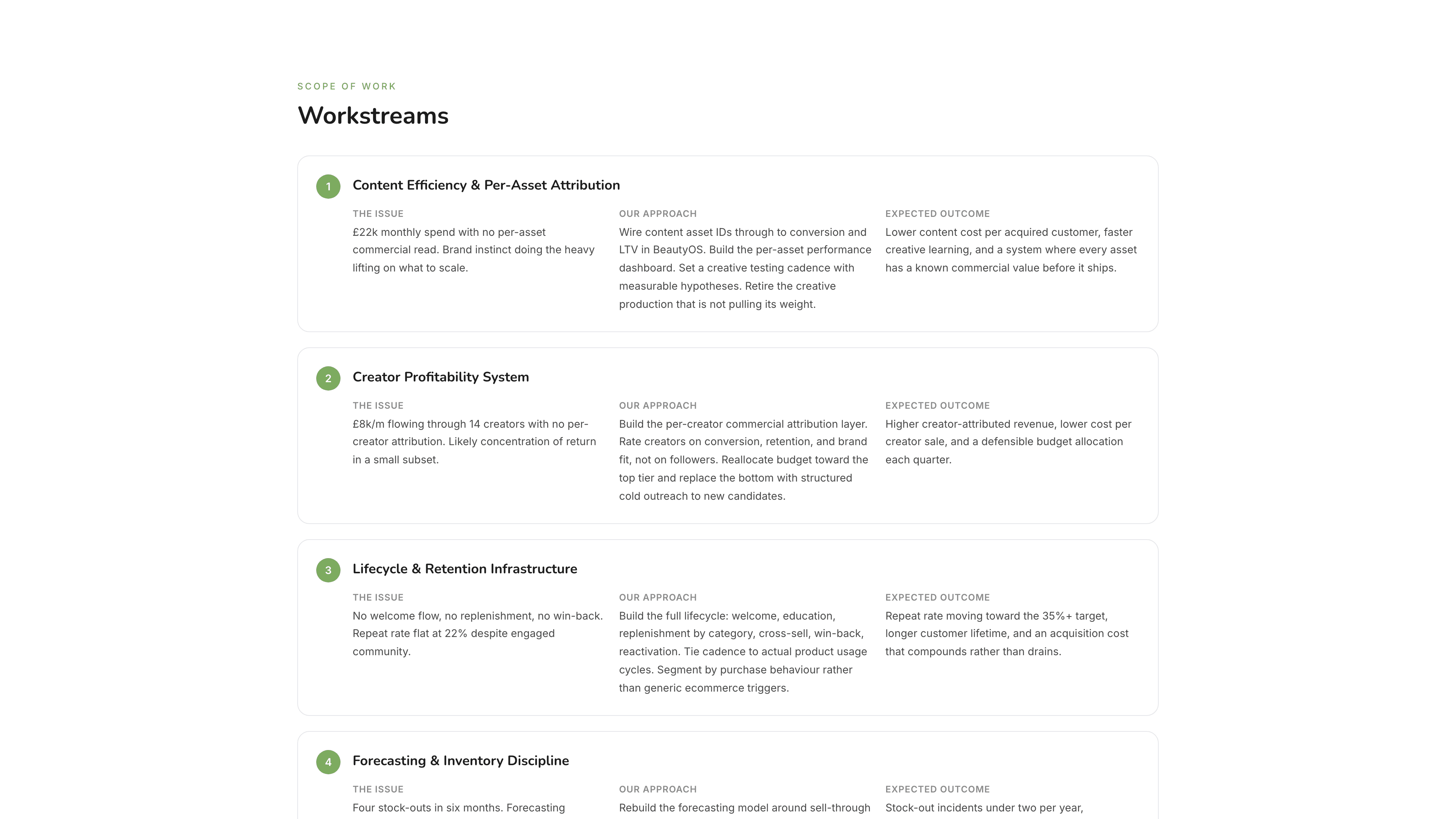
Scope of work
The issue
£22k monthly spend with no per-asset commercial read. Brand instinct doing the heavy lifting on what to scale.
Our approach
Wire content asset IDs through to conversion and LTV in BeautyOS. Build the per-asset performance dashboard. Set a creative testing cadence with measurable hypotheses. Retire the creative production that is not pulling its weight.
Expected outcome
Lower content cost per acquired customer, faster creative learning, and a system where every asset has a known commercial value before it ships.
The issue
£8k/m flowing through 14 creators with no per-creator attribution. Likely concentration of return in a small subset.
Our approach
Build the per-creator commercial attribution layer. Rate creators on conversion, retention, and brand fit, not on followers. Reallocate budget toward the top tier and replace the bottom with structured cold outreach to new candidates.
Expected outcome
Higher creator-attributed revenue, lower cost per creator sale, and a defensible budget allocation each quarter.
The issue
No welcome flow, no replenishment, no win-back. Repeat rate flat at 22% despite engaged community.
Our approach
Build the full lifecycle: welcome, education, replenishment by category, cross-sell, win-back, reactivation. Tie cadence to actual product usage cycles. Segment by purchase behaviour rather than generic ecommerce triggers.
Expected outcome
Repeat rate moving toward the 35%+ target, longer customer lifetime, and an acquisition cost that compounds rather than drains.
The issue
Four stock-outs in six months. Forecasting accuracy 67%. Working capital tied up in slow SKUs while bestsellers run out.
Our approach
Rebuild the forecasting model around sell-through reality, not optimism. Run weekly stock-runway checks in BeautyOS. Set replenishment triggers per SKU based on category cadence. Free working capital trapped in over-ordered SKUs.
Expected outcome
Stock-out incidents under two per year, forecasting accuracy above 85 percent, and working capital available for the brand decisions that compound.
The issue
Two retail buyer conversations stalled on missing documentation. Compliance dossier incomplete. No sell-through file the buyer can underwrite against.
Our approach
Build the compliance dossier (MoCRA for US, EU CPNP for Europe, claims substantiation). Compile the sell-through and retention evidence retail buyers need. Set up the operational backbone retail expansion requires before the next conversation.
Expected outcome
Retail conversations move from stalled to live. Buyer due diligence completes in days, not months. New retail doors open without delaying the rest of the business.
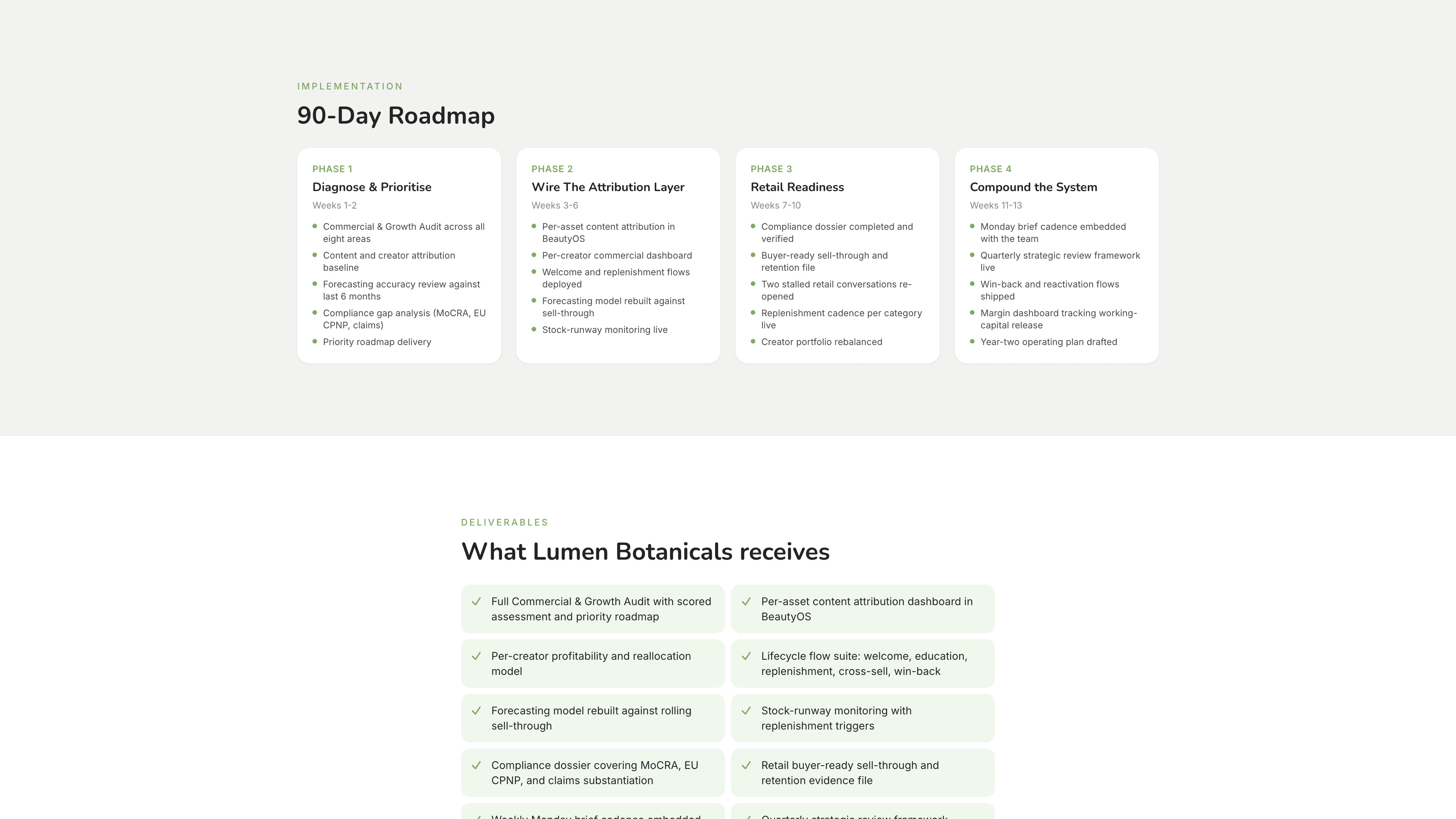
Implementation
Phase 1
Weeks 1-2
Phase 2
Weeks 3-6
Phase 3
Weeks 7-10
Phase 4
Weeks 11-13
Deliverables
Why Beauty 2.0
We work exclusively with beauty and wellness brands. Replenishment cadence per category, creator LTV, retail door behaviour, ingredient and claims compliance are not edge cases for us. They are the substrate.
We do not optimise individual channels in isolation. We build the connected operating model where content, creators, lifecycle, forecasting, and compliance reinforce each other. Fixing one while the others leak is a waste of budget.
Every recommendation carries a commercial rationale. We suggest changes because they will measurably move revenue, margin, or working capital. Not because they are best practice.
AI prepares the drafts. A senior operator reviews and signs off before anything reaches you. AI prepares. Beauty 2.0 decides.
Future phase
Once the core growth leaks are stabilised, Beauty 2.0 can support Lumen Botanicals with a set of high-impact expansion modules designed to increase conversion, strengthen owned demand, improve subscriber quality, and maximise customer lifetime value. Each module can be added independently, when the timing and budget are right.
A dynamic site experience that changes messaging, proof, and conversion journeys based on visitor source and lifecycle stage. Stronger relevance, better paid efficiency, higher conversion.
Owned-discovery expansion: SEO architecture, answer-first content, AI search visibility, comparison pages, geographic optimisation. Stronger non-paid acquisition.
Forecasting layer with category-level sell-through, supplier lead-time modelling, pre-stockout intervention, and capital optimisation. Fewer stock-outs, healthier working capital.
Per-door sell-through analytics, replenishment recommendations, buyer review pack generation. Stronger retail expansion, faster buyer due diligence.
A premium subscription proposition tied to results, not discount. Milestone communication, progress-led support, subscriber-only benefits.
AI-powered learning across paid, creator, and UGC performance. Distinguish hooks that drive profitable customers from those that drive cheap traffic. Smarter content investment.
MoCRA, EU CPNP, and claims substantiation continuously kept current. Pre-launch claims pre-check. Document version control. Reduce regulatory and retail risk.
A branded on-site assistant offering routine recommendations, ingredient education, objection handling, bundle suggestions. Stronger conversion confidence.
Executive operating view: unified visibility across acquisition, conversion, retention, subscription, LTV, content, and creator performance. Faster decisions, less spreadsheet chaos.
A longer-term vision
Beyond the immediate operational fix, Lumen Botanicals has the opportunity to become one of the brands the next generation of beauty buyers learns by name. The product is strong enough. The community is loyal enough. What is needed is the operational discipline to compound that position over the next thirty-six months without losing the brand sensibility that earned the position in the first place.
The engagement above stabilises the operating layer. The expansion modules are the path from stable to genuinely scalable. Each one can be added independently, when the timing and budget are right, without disrupting the work that is already paying back.
Recommended next step
Begin with the Commercial & Growth Audit. A structured two-week diagnostic that validates exactly where the biggest leaks are, quantifies the opportunity, and produces a prioritised roadmap for the 90-day implementation sprint.
Prepared by Beauty 2.0 for Lumen Botanicals. Sample.
Confidential. For internal discussion only.